01 Rippl'
Rainwater as a Shared Resource – back to the front page
A balcony-mounted rainwater collector with a sensor, and an app that makes rainwater reuse easy and visible for apartment residents in Aarhus.
The challenge
It rains plenty in Denmark. So why aren’t we doing more with our rainwater?
Reusing rainwater at home is almost nonexistent in Denmark, even though it is possible. Water is cheap, there is no municipal subsidy, and a rainwater tank takes 10 to 15 years to pay for itself. Most systems are also built for people with a garden, which leaves out everyone living in an apartment.
Our research kept pointing the same way: sustainability and community motivate people far more than savings. So the task became designing a solution that does not rely on an economic payoff.
Outcome
Rippl' ended as a tested app concept, a brand and a simple physical mockup, presented at an exhibition booth. It was never built or launched, so we cannot say whether it would change behavior.
What we can say is how people responded. At a critique session, Grundfos reacted well to the gamification and to community as a source of motivation, and pointed out that many of their colleagues already track their electricity use and solar output.
Process
-
01
Site visits
Visits to a utility company and an industry partner.
-
02
Desk research & competitive audit
Desk research and a competitive audit.
-
03
Expert interviews
Three expert interviews: a rainwater retailer, an industry partner and a project manager from NYE, a new sustainable town outside Aarhus that already reuses rainwater.
-
04
First concept
We first considered a subscription model, run either by a private company or together with the municipality.
-
05
Critique session, October
In our first critique session in October, we were told this did not match what actually motivates people.
-
06
The pivot
We reframed the concept and pivoted to a nonprofit model built on community rather than economic gain.
What the research led to
The research gave us four clear directions: make it affordable, social, visible and effortless.
A low entry fee, with funds and sponsorships as possible ways to cover the rest, rather than profit.
A community layer where users share photos and help decide which flowers get planted, plus a gamification element that turns collected water into contributions to local biodiversity.
An app overview of collected rainwater, compared with the community over flexible time periods.
A balcony collector with a sensor that tracks automatically, so nothing needs logging by hand.
The design


01 / 03
A name and a look that make rain feel playful
I suggested the name Rippl' after the ripple effect we hoped to create: small actions that spread outward. Collecting rain should feel fun, not like a chore, so I led the visual direction, from the color palette and typography to the icons.
Round shapes, soft icons, gentle shadows inspired by neumorphism and muted pastels give the app a light, clean look. Together with my team, I built the system in Figma with styles, components, variants, interactions and auto layout.
The home screen
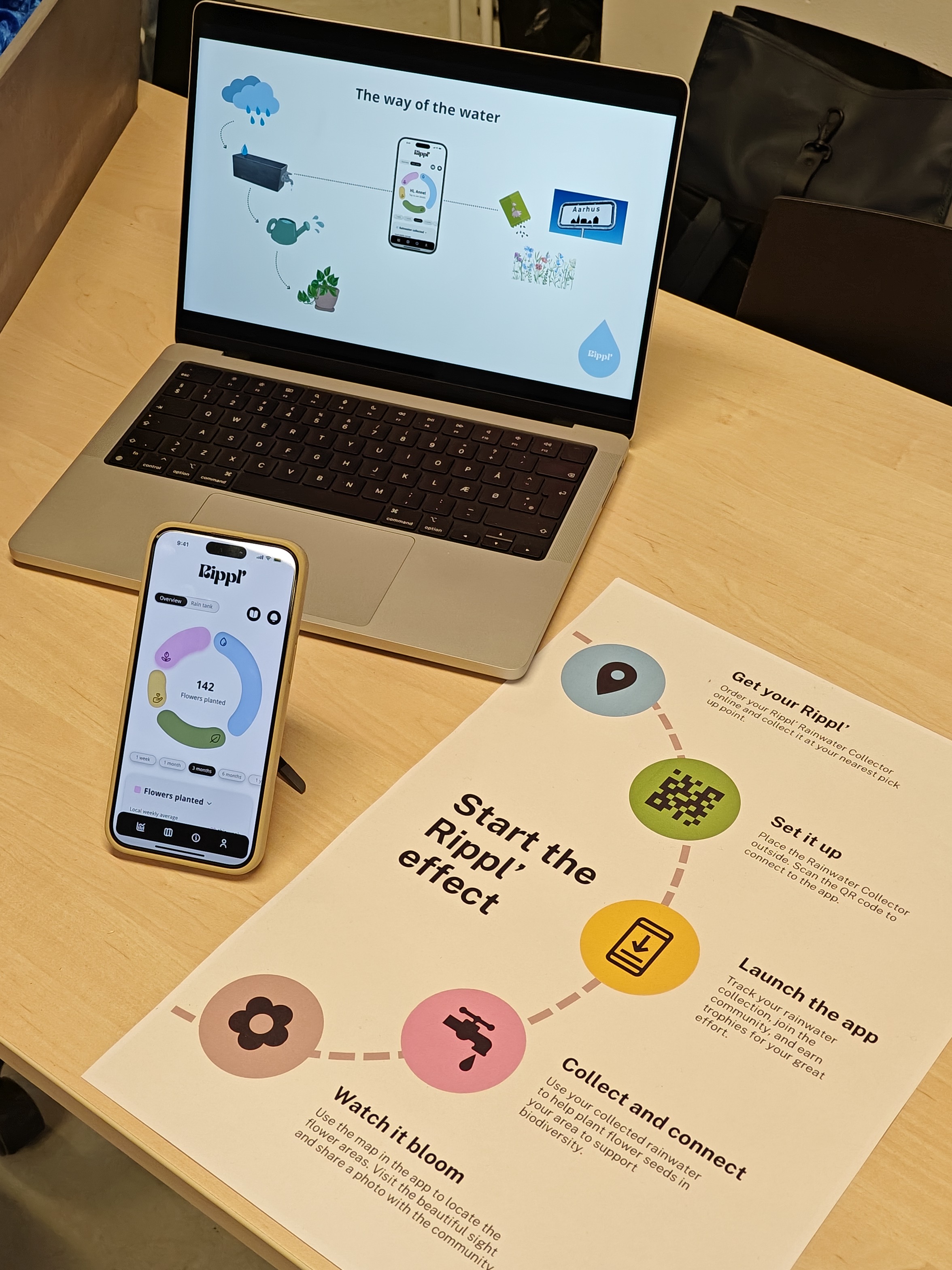
It is built around one question: how is my rain collector doing? Like the apps people already use to follow electricity or solar output, it puts the numbers first: rainwater collected and used, the water level in the collector, and the areas and seeds users have helped plant nearby.
Scrolling down, it widens from the personal to the shared, comparing your collection with the community’s over weeks, months and years. A weather forecast at the bottom turns the numbers into a decision: if the collector is nearly full and heavy rain is coming, it is time to empty it. I also designed the info page, which explains rainwater reuse and biodiversity.
Beyond the screen
We presented Rippl' at an exhibition booth with posters, slogans and a simple physical mockup, made to show the look and feel rather than to work, since we did not manage to order the sensor in time.
Test & Refine
We tested the app with eight classmates who were familiar with the brief on sustainable water futures. Each participant thought aloud while using the app, then filled out a short survey independently.
For us, it was important that collecting water felt easy and playful. Collecting rainwater is not exactly exciting on its own, so a core value of Rippl' is to make the experience more engaging. We therefore asked participants to evaluate how easy to navigate and enjoyable the app felt, while also testing whether they could easily find their collected water and impact on the map, and whether the home screen made sense at a glance.
The test led to refinements rather than structural changes. We enlarged buttons to make them easier to tap and clarified a few flows. The visual design and gamification were particularly well received, both during testing and later at the exhibition.
Because our testers already knew the brief, they were better at identifying unclear interactions than assessing whether the concept would appeal to everyday users. Still, their feedback helped us refine the experience and strengthen the playful side of Rippl'.
Reflection
What I learned
Rippl' taught me how closely business model and user experience are tied together. Giving up the subscription model showed me that the right solution is not always the most obvious one commercially, it is the one that matches what actually motivates people. I also learned to turn complex stakeholder knowledge into a simple, concrete product.
With more time
I would have tested the app with apartment residents instead of classmates, to see whether the gamification keeps motivating people over time.
The right solution is not always the most obvious one commercially, it is the one that matches what actually motivates people.